

12 Ways to Save on Your Next Car Lease in Draper, Utah


Leasing a car in Draper, Utah, doesn't have to drain your wallet. After helping hundreds of local families and professionals navigate lease agreements, we've identified the most effective strategies to reduce costs while getting the vehicle you want.
Whether you're commuting from Draper to Salt Lake City or exploring the nearby Wasatch Mountains, these 12 proven tactics will help you lease smarter and save more.
1. Master the Money Factor to Lower Your Interest Costs
The money factor is leasing's version of an interest rate, expressed as a tiny decimal (like 0.00125) rather than a percentage. In our experience working with Draper lessees, dealers often have flexibility on this number, but only if you ask. To convert it to an APR equivalent, multiply by 2,400.
Lowering the money factor from 0.00150 to 0.00125 on a $30,000 lease can save you approximately $540-720 over a 36-month lease. Request the money factor in writing and compare it against current market rates for your credit tier. Credit unions in the Salt Lake Valley sometimes offer competitive lease financing that can beat dealership rates.
2. Leverage High Residual Values to Finance Less Depreciation
Residual value represents what the leasing company predicts the car will be worth when your lease ends, typically shown as a percentage of MSRP. We've found that certain vehicles hold their value exceptionally well in Utah's market.
A vehicle with a 60% residual after three years means you're only financing 40% depreciation. Toyota and Lexus models consistently show residuals 5-10% higher than many competitors. On a $35,000 vehicle, improving residual from 55% to 60% reduces your financed amount by $1,750, potentially lowering monthly payments by $50-60.
3. Negotiate the Capitalized Cost Like You're Buying
The capitalized cost (cap cost) is the agreed-upon price of the vehicle for lease purposes. Many Draper residents don't realize this number is negotiable. Research fair market values using Kelley Blue Book, Edmunds, and TrueCar before visiting dealerships.
Negotiating the cap cost down by $2,000 typically reduces monthly payments by $55-65 on a 36-month lease. Start negotiations below the invoice price, not MSRP. In the current market, many popular models have manufacturer incentives that dealers can apply to lower your capital cost significantly.
4. Maximize Your Trade-In Value to Reduce Upfront Costs

Your current vehicle's value can be applied as a cap cost reduction, lowering what you finance. After appraising thousands of trade-ins in Draper, we've learned that most drivers leave money on the table by accepting the first offer.
Get independent appraisals from CarMax, Carvana, and at least two local dealers before committing. A fair trade-in appraisal versus a lowball offer can differ by $1,500-3,000. Utah's robust used car market, driven partly by population growth along the Wasatch Front, often yields competitive trade-in values, especially for trucks, SUVs, and AWD vehicles popular in Draper.
5. Challenge Unnecessary Fees to Keep More in Your Pocket
Common lease fees include acquisition fees ($500-995), disposition fees ($300-500), and various dealer add-ons. We've successfully negotiated away or reduced fees for our Draper clients by questioning each line item.
Acquisition fees are sometimes negotiable or can be rolled into the lease. Disposition fees might be waived if you lease again from the same brand. Eliminating or reducing fees by just $600 can save $15-20 monthly over a three-year lease. Watch for documentation fees above $300, unnecessary dealer add-ons like fabric protection, and inflated bank fees.
6. Choose Fuel-Efficient Hybrids to Cut Operating Costs
Hybrid vehicles combine gas engines with electric motors for superior fuel economy. Our data from local clients shows hybrid drivers save substantially on fuel. The Toyota Prius averages 54 MPG combined, Prius c achieves 46 MPG, and Camry Hybrid delivers 51 MPG, compared to 28-32 MPG for comparable gas-only sedans.
If you drive 15,000 miles annually in Draper, upgrading from a 30 MPG sedan to a 50 MPG hybrid saves approximately 200 gallons yearly. At Utah's average gas price of $3.50/gallon, that's $700 annual savings, $1,750 to $2,100 over a typical lease term. Hybrids often have higher residual values, which further reduces your monthly lease payment.
7. Research Utah-Specific Hybrid and EV Incentives
While Utah's state tax credit for hybrids is limited compared to full EVs, opportunities exist. Rocky Mountain Power offers rebates for electric vehicle charging equipment. Some Draper-area employers provide charging infrastructure and commuter incentives.
Federal tax credits primarily favor plug-in hybrids and full EVs over standard hybrids. However, manufacturer lease incentives on hybrids can reach $1,000-2,500 in cap cost reductions. Check the Utah Office of Energy Development and Rocky Mountain Power websites for current incentive programs.
8. Optimize Your Down Payment Based on Risk Tolerance
Money paid upfront (cap cost reduction) lowers your monthly payment but creates risk if the vehicle is totaled early. Zero down preserves cash and protects you from loss in early accidents. However, moderate down payments ($1,000-2,000) can make monthly costs more manageable.
A $2,000 down payment typically reduces monthly costs by $55-65 over 36 months. But if the car is totaled in month 6, you've lost most of that $2,000. For most Draper clients, we suggest zero to minimal down payment with the savings invested in comprehensive gap insurance. Utah's winter driving conditions increase accident risk seasonally.
9. Select the Right Mileage Allowance to Avoid Penalties

Annual mileage limits (typically 10,000, 12,000, or 15,000 miles) are included in your lease, with per-mile charges for overages. Calculate your typical annual mileage by checking current odometer readings, then add 10% buffer for lifestyle changes.
Overage fees run $0.15-0.30 per mile. If you choose 10,000 miles but drive 13,000, you'll owe $450-900 at lease end. Purchasing that extra 3,000 miles upfront typically costs $300-450, a significant savings. If you commute from Draper to downtown Salt Lake City (approximately 20 miles each way), that's 10,000+ miles annually just for work.
10. Plan Your Lease-End Strategy Before Signing
Understanding your options when the lease term expires, return, purchase, extend, or transfer, prevents costly last-minute decisions. Document the vehicle's condition with photos at the lease start to protect against disputed damage charges.
The lease contract specifies a predetermined buyout price. If the market value exceeds this price, purchasing and immediately reselling can net you a profit. We've seen Draper clients gain $2,000-5,000 this way. Extensions typically continue at your current monthly rate, while lease transfers let someone assume your remaining payments.
11. Understand Excess Wear-and-Tear Standards to Avoid Charges
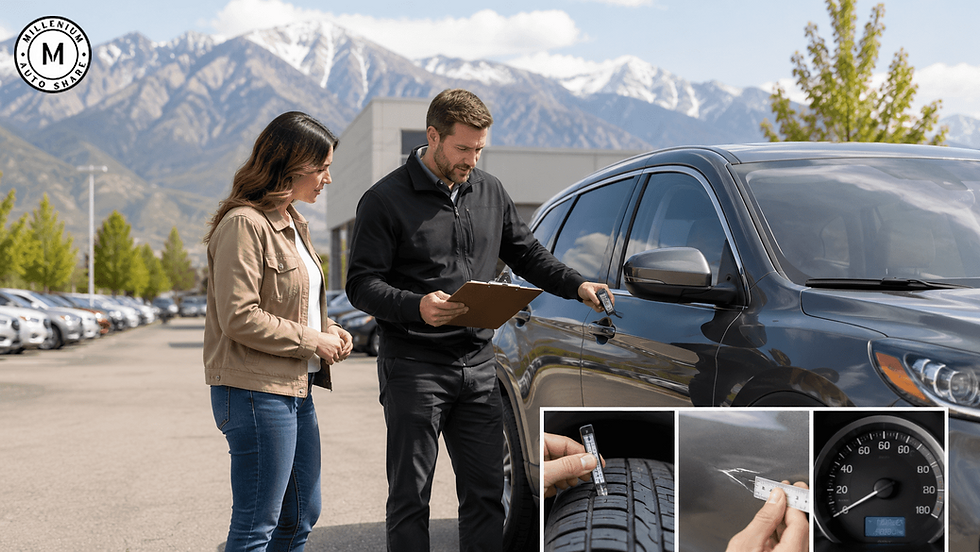
Leasing companies assess vehicle condition at return and charge for damage beyond "normal wear and tear." Most companies tolerate door dings under 2 inches, minor scratches that don't penetrate paint, and small windshield chips away from the driver's sight line.
Excess wear charges typically run $50-150 per damaged area, quickly reaching $500-1,500 if multiple issues exist. Professional pre-inspection services ($100-200) identify problems you can fix economically before return. We recommend Draper clients invest in quality floor mats, periodic professional detailing, and paintless dent removal as needed.
12. Compare Total Lease Cost Against Purchase to Make Informed Decisions
We provide this analysis for every Draper client because the "right" choice varies by situation. Leasing makes financial sense if you drive under 15,000 miles annually, want a new car every 3-4 years, and value warranty coverage throughout your ownership.
A $35,000 vehicle with 5% financing over 60 months costs approximately $661 monthly. Three consecutive 36-month leases at $399 monthly total $43,164 paid over nine years, with zero equity, but you've driven three different vehicles under warranty. Our data shows that lease payments typically exceed the depreciation cost of buying and holding for the past 6-7 years.
Quick Reference: Key Lease Savings Strategies

Strategy | Difficulty | Potential Monthly Savings | Time Investment |
Negotiate money factor | Moderate | $15-25 | 30 minutes |
Reduce capitalized cost | Moderate | $50-80 | 2-3 hours |
Choose higher residual vehicle | Easy | $40-60 | 1 hour research |
Maximize trade-in value | Easy | Varies ($30-85/mo equivalent) | 3-4 hours |
Select optimal mileage package | Easy | $125-300 annual savings | 15 minutes |
Lease fuel-efficient hybrid | Easy | $60-80 (fuel savings) | 1 hour research |
Start Saving on Your Draper Car Lease Today
These 12 strategies can save you $1,500-3,000 over your lease term. Focus on the highest-impact moves: negotiating capitalized cost, selecting the right mileage allowance, and choosing high-residual vehicles.
At Millennium Auto Share, we help Draper residents structure smarter leases through transparency and education. Our team will show you actual numbers, compare deals, and build a lease aligned with your budget.
Browse our inventory or schedule a consultation, and we'll provide a personalized savings analysis with no obligations.
Frequently Asked Questions
1. What should I consider when choosing a car lease length?
Consider your desired monthly payment (longer leases cost less monthly), how often you want new technology, and your annual mileage needs. Most Draper clients choose 36-month terms for the best balance of payment, flexibility, and warranty coverage.
2. Are there hidden fees I should watch for when leasing a car?
Common fees include acquisition fees ($595-995), disposition fees ($350-495), documentation fees ($150-300), and excess mileage charges ($0.15-0.30/mile). Watch for inflated "bank fees," dealer add-ons like VIN etching, and market adjustments. Always request an itemized breakdown.
3. How can I improve my credit score before leasing?
Start 3-6 months ahead by paying down credit card balances below 30% utilization, making all payments on time, avoiding new credit inquiries, and disputing any credit report errors. A 50-point increase can save you $20-40 monthly on lease payments.
4. What should I do if I exceed my lease mileage limit?
Purchase additional miles before lease end (30-50% cheaper than overage fees), consider early termination with a new lease, or exercise your buyout option and resell the vehicle if market value is favorable.
5. Can I lease a car with bad credit?
Yes, though expect higher money factors, larger down payments, and limited vehicle selection. Improve approval odds with a co-signer, stable employment proof, or by choosing less expensive vehicles.


Comments